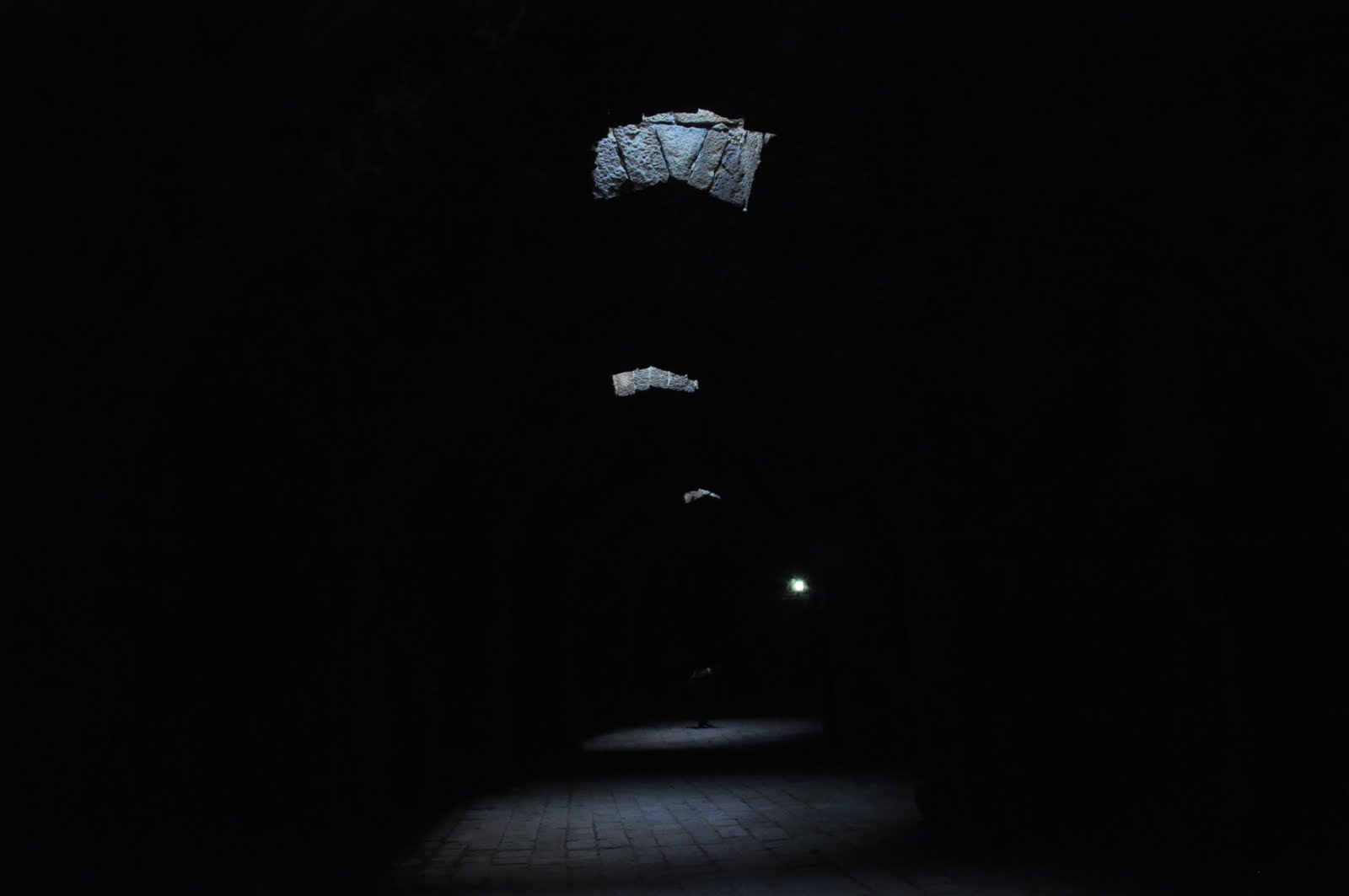
There Is Always Light at the End of the Tunnel

|

Set by Afi, Muhammad Asri took these photos when they visited the Roman Amphitheater at Busra. It was shot along the corridor of the Roman legacy and the subject was Muhammad Afiq. I called it ‘there is always light at the end of the tunnel’. Yes, Allah swt has always provided us the light, the path to achieve success. In fact, the light comes from various directions. However, it is up to us to put our efforts to find the ‘light'. Wish them all the best in their pursuit of happiness - the true sense of happiness.

Exploring the Night Life of Souk Sirijeh, Damascus

|

We arrived Dimashq around 19:10 hours and went to a place called Masaqin for what Amir called Syrian ‘Nasi Mandi’ dinner, but rather a Yemeni cuisine of Syrian Lamb and Chicken Briyani. The succulent Syrian Lamb or Lahmah Dhoni had tempted my appetite that I have to ignore the alerting level of Uric acid circulating in my blood. The Yemenian relaxation style of dining was another memorable experience for all the kids.
The above photo: Amazed by the architecture of Bab el Jabieh and enthusiastively attentive listening to Amir's story of one of the seven doors of the old city.
After the dinner, we took two taxis to one of the well-known spots of Dimashq that is well known by tourist, the Souk Hamidiyyah or Souk Hamidi by the Local. Actually, our main intention was to perform our obligation at the Grand magnificent Umayyad Masjid or Masjid Umawi in the Local dialect, which is one of the most prominent features of Syria. I will share about the Masjid in my later entry.
Various colors and taste of the local olives that decorated the alley of Souk Sarijeh. In the photo below: all sorts of local fruits were nicely presented to lure customers. Awesome, aren't there?
After had satisfactorily fulfilled our obligation, we went to Souk Thawil or the Long Bazaar or Madha Pasha Bazaar, which is parallel with Souk Hamidi. Most of the shops out of service I mean closed. All the places I mentioned above are within the old city of Damascus, which has 7 main Gates. And, one of it is Bab el Jabieh, which we went through to Souk Sarijeh (am not too sure I pronounce it correctly) in the Local dialect.
Nana bought some pastries and a kilo of the local orange or Buktuqal. The price - was rediculously cheap.!
Can't remember the name of this species. There were warmed above the hot charcoal.
Goat head or Ras Khorouf was very popular in Syria. One could find many restaurants serving the dish. How they serve and consume was not sure for me though. Nevertheless, it was an eye opening experience to the kids. All this while, they normally heard about the goat head story in one of the hadiths during our ‘ta’lim’ session.
There were few pastries masteries and/or halawat shops along the Souk. We bought something similar to baklawah in Egypt – I think Manahourah (please do not quote me!). I must say; it was really mouth watering crumply delicacies.
We tried these sweety deserts, made from cheese, milk, wheat, sugar and sprinkled/decorated with sliced pistachios. I have tasted both and must say - yummy, yummy....delicious.
Souk Sarijeh was basically accommodating the Local produces vendors, which was still busy during this odd ours. The people that we met were very friendly, accommodative, helpful and polite. It was really an awesome experience roaming the alley in the middle of the night entertained by the beautiful colors, shapes and characters of the inhabitants. Despite the hectic agenda, most of us still have sufficient energy to walk through the nite. Anyway, we decided to call it a day - time ticked 23:37 hours. Masalamah

Morning Walk along D'Mas Back Lane

|

The main item in our second day agenda was visiting the tomb and shrine of many important prominent people in the Islamic history – a trail blazer on their own businesses. Among them was Bilal bin Rabah radiallah hu anh (ra); Abu Hurairah ra; the wives of the Messenger of Allah swt and many more.
We had a superb sleep and after fully recovered from the day 1 hectic program, we started our day by strolling leisurely along the back lane of the downtown Damascus.
It was around 07:30 hours, amid the chilly freshly ambience of Dimashq, many shops were still closed. The lane provided an opportunity to experience and admires the architecture of the old buildings. Akin to some other parts of the Middle East downtowns and villagers, the building looks old and decent from outside but, it will be another totally different picture if you go in. The saying goes; ‘don’t judge the book by its cover’.
The street however, was filled by gorgeous and charming Syrian kids headed to their respective schools. Some old men were preparing their kiosks gave us their hospitable smile and greetings that cheered our day. Not Ayman though, he was still dozing off, I mean sleep-walking!

Syrian Breakfast to Start the Day

|

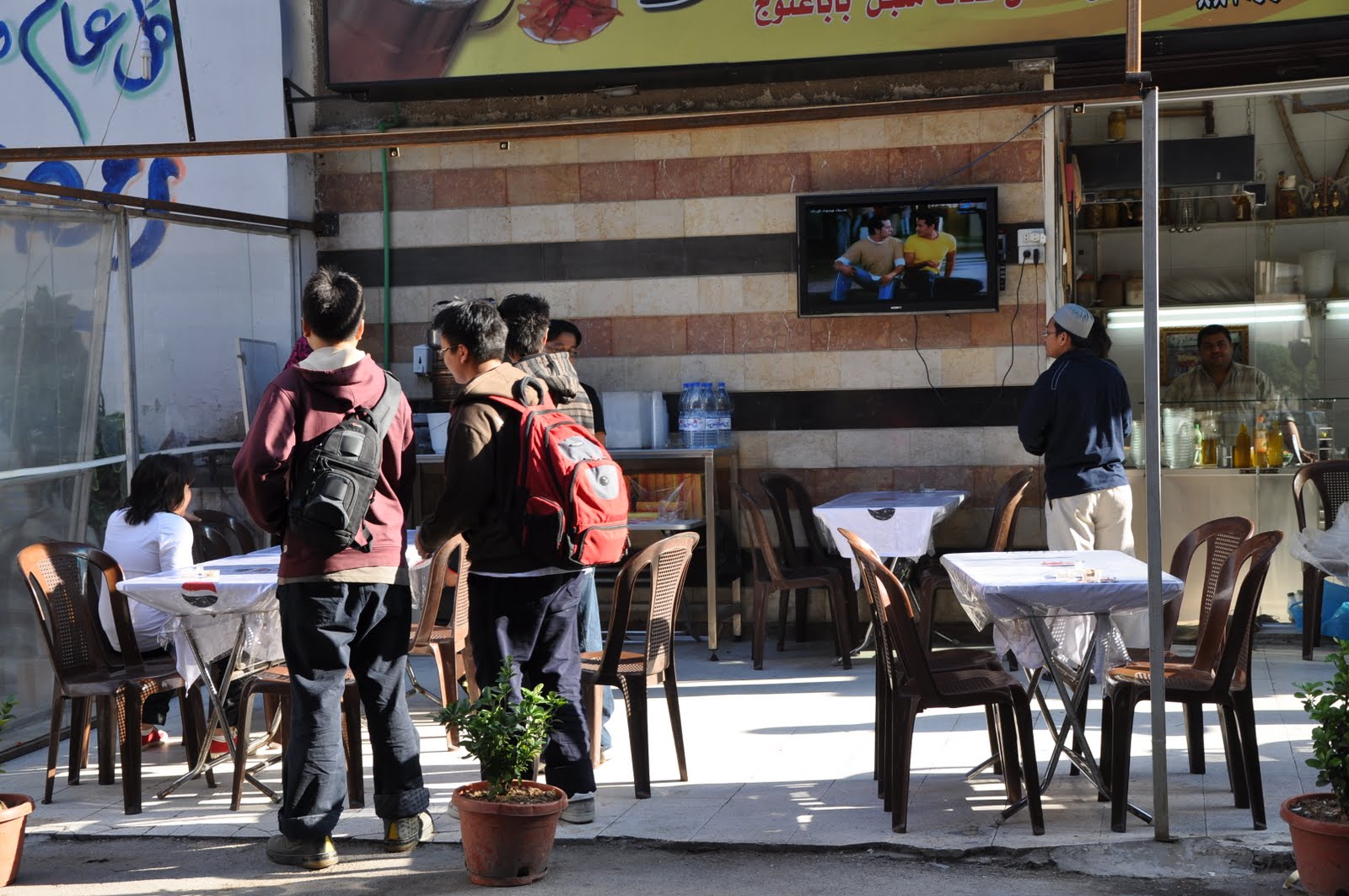
After around 15 minutes walk, we stopped at this small restaurant along the main road to fullfil our biological needs. Relatively speaking, it was still early for the people, thus, there was basically only us patronizing the clean and hygiene restaurant. Besides the cleanliness and its decency, the hospitality of the crew were commendable and it has flat screen TV with satellite decoder attached to it.
Albeit the menu did not show us ‘Nasi Goreng’ or ‘Roti Canai’ or other typical Malaysian breakfast set, we had really, an excellent Syrian breakfast. The ‘humus ma halib’ or blended chick peas with yoghurt with some mint, etc. was the main dish of the day. Almost four medium size of this dish were consumed with some assorted local pickled. . I am quite lucky that, my team – wife and kids were not fussy with food and very adventurous in many aspects – clothing, accommodation, transportation or even the program itself. They were very cooperative and understanding. Thanks team.
Based on our agreed plan, today, we spent 90% of the day on foot. Hence, he breakfast was quite essential that had kept us energized.

The Majestic Mount Qasiyun


First agenda of the day was climbing Mount Qasiyun for visiting Maqam El-Arba’in - tomb of the 40 Saints or Walis in Malay, and place claimed to be the spot where Habil (Abel) murdered by Qabil (Cain). Will share it later.
We took two taxis (fortunately the taxi allowed 5 persons in their car) from the restaurant and arrived at the minivan station at the foot of the Mount Qasiyun of Abdel Ghani En Nabish street at Abu Jerash district 10 minutes later around 08:40 hours.
Photo above: The starting point of our flight by foot to the tomb. I remembered Amir asked us to count the steps, but I only managed counting it up to 200 plus. What a useless effort! I mean what the heck that we unnecessarily wasted our energy - counting the stairs? For what???!
The minivans were literally a very unusual (to me) mini size vans. Believed me, these mini China made vans are the main public transport other than small size pick-up trucks, mobilizing people from the mountain foot through the narrow alley and steep slope of the village. Azmi approached one of the drivers but turned it off because the high fare that he charged. Normally, to reach the Maqam Al-Arba’in for roughly 2 hours visit (including the ascending and descending the mountain), one should charter one van for around 250 Syrian Pound (SP), i.e., around 20 RM. Another driver eventually agreed to drive us for 250 SP per van.
We cut the deal, and there we were a 15 minutes amusing and amazing ride along the alleyways of Al-Salihiye to the mid-point of the mountain. The ride was far more exciting that words could explain, especially when another vehicle came rolling down the steep cliff alley and yours backed-up into the house or store of a local guy to give them space. After we reached the end of the road, we then climbed a flight of what Amir said 637 stairs, I mean uneven 637 concrete stairs
It is rightly said that the flight leading to the tomb is a climber’s delight. As we ascended the steep hill breathtaking scenery unfolded before your eyes. The weather was really on our side, alhamdullillah. The view of the Damascus city from the top was awesome, even the two minarets of the Ummayad Masjid were distinctly visible. At times thick mists could momentarily obscure the scenic landscape scenery disappointing enthusiastic shutterbugs. Alhamdullillah - praise only for Allah swt, we finally made it to the majestic Mount Qasiyun.

ZS10: The Meeting Place of the 40 Saints


Nana and Afiqah in white & black posed with group of conservative Syrian women and ladies in black. They spent their time and made the visit to this shrine, which they believed the best place to supplicate and pray before Allah swt. They were very friendly and surprisingly supportive.
Maqam Al-Arba’in is a shrine believed to be, by the local and many Muslim Scholars, the place from which the spirit of the 40 Saints or Arba’in in Arabic, descends every night and ascends with the break of dawn. The mihrabs (prayer niches) on the upper floor are believed to be where the Saints or Walis prayed the night vigil prayers every night.Besides the meeting place of the 40 Saints, Amir explained that, the other scared mihrabs on the lower level are believed to be the spots at which Prophet Ibrahim alaihissalam (a.s.) and Prophet Khaidir a.s. met and prayed during their flight through Damascus.
The shrine is built on the site where the Biblican and Quranic murder of Habil, the son of Prophet Adam a.s. by his brother Qabil is believed to have taken place. It has all the basic facilities for visitors and well maintained by the family (tasked by the government authorities, I believed) inherited service of the shrine.

ZS11: Place of the First Murder Case in Human History


The 20 minutes climb was really hectic, which consumed almost half of my energy produced by this 45 years old 300 horsepower engine! It reminded me about those old days when I was placed in Bintulu, in the late 90s, jungle and mountain trekking was one of my craze leisure activities, other than cycling, golfing and sometime jogging. What else to do though in Bintulu then? Well, that was 10 years ago. Nevertheless, after releasing my biological waste and almost spending 20 minutes in the Maqam al-Arba’in whilst learning from Amir a little bit history of the place, alhamdullillah, the exhaustion and the pain subsided. Amir called the caretaker named Musbah, a very decent and friendly young Syrian man, for us to visit another important momentous spot in the Islamic history – the site of where the murder of Habil (by his brother Qabil) is believed to have taken place.
Musbah, before he unlocked and opened the small 3’ X 5’ door to the ‘cave’, reminded us for no photos shooting, whatsoever. Upon entering the door, we went through a short alleyway where the caretaker placed their belongings, religious books, Mushaf Al Quran El Kareem, etc. The 8 feet long (4 feet wide and the ceiling is about 8 feet) passageway brought us to a big spacious and well maintained chamber. The chamber is divided into two compartments; one big portion is for prayer (there is a small niche showing the Qibla direction) and meditation. Another small chamber separates by wooden fence (and door), is where one could see a hand-like figure casted on the ceiling (6 feet from the floor). This hand-like figure is believed to be a hand-print of Saidina Jibrail a.s. who tried to prevent the earth who was trying to engulf Qabil. Within the cave is a grotesque image of a mouth in the rock, said to have been formed when the earth cried out and shocked at the awful deed. Amir explained further that, the earth always thought that human being is a very decent creatures and could not believed what had happened. One could see water drops from the middle part of the hand-like figure, claimed to be the tears of the earth, which mourned the killing of Habil. Next to the grotesque is a small shaft (with 3 holes) into the mouth of the mountain which is believed to be, according to local tradition, the place from which the spirit of Damascus' 40 saints descends every night and ascends with the break of dawn.
It was really an amazing and astonishing experience for all of us. This lifetime experience had enhanced our knowledge and reminded us on the importance of complying to Allah swt Rules and Instruction, shown and demonstrated by His Messengers, in our case, Prophet Muhammad saw (peace be upon him). We adjourned after spending around 20 minutes inside the cave.

Descending Mount Qasiyun


Masalamah Ahlul Arba’in. We left the place with mixed feeling and descended the mountain at 10:15 hours. Going down was painless. Afiqah and Aiman took merely 5 minutes, were the first to arrive at the midpoint. Their brothers who always have lot of stories sharing took their ample flight down. Nana, her friendliness, inherited from her late beloved mother, spent few minutes with Swiss family who was on the way up. The friendly mother is pursuing Islamic studies in Damascus and had been here since two years.
As we were approaching the midpoint we met another group of very jovial and friendly Syrian boys. As usual, the typical Syrian, after we greeted each other, few of them were asking me to take their photo. Lucky me and thanks to the digital technology that allow me to shoot as many photos as I like.
Pheewww, finally, we reached the midpoint and the two minivans drivers were there patiently waiting. We met this young cute ‘guy’ (above photo) strolling alone along the alley and greeted this lovely romantic couple (photo below) who were dating in front of their decent house while enjoying the Qasiyun breeze. These are colors of life that made our live more beautiful. It has been distinctively and meticulously crafted by the Almighty Allah rabbul jalil.

....15 minutes Walk through Abu Nour district

|

Alhamdullillah salamah. After the fascinating ride along the narrow alleyway, we reached the minivan’s station at the Mount Qasiyun foot at 10:45 hours. We decided to walk through Abu Nour district expected to reduce some calories from the lamb and chicken beriyani.
We had a brief stop at the modern cotemporary bus-taxi stands. It was well maintained and cleaned, no sign of vandalism and equipped with a comprehensive map of Damascus – for tourist and local alike. There was nobody there though at that time, so we spent few minutes listening to Azmi’s story about the district. He explained there are number of Malaysian study at one of the Islamic Colleges here. In general, the cleanliness of this serene district was commendably remarkable and the area is well organized. However, what really pleasing and impressed us was the hospitality and the natural beauty of the people.

The only Malay Restaurant @ Damascus

|

Amir and Azmi brought us to Rafaqa restaurant – if I recalled it correctly – a Malay restaurant operates by the Malaysian student. We arrived there at 11:35 hours after the 15 minutes’ walk along the Abu Nour district, for our brief refilling – I mean lunch.
It was a small size corner-lot restaurant that served the typical Malaysian cuisine, such as, chicken curry, fried rice, ‘teh tarik’, the O ais Limau’, etc. The service was excellent and the cleanliness was superb. The scrumptious menu was customary break for us and the price was ridiculously reasonable.
After the brief lunch, we took two taxis for our next important agenda, visiting the shrine and the tomb of prominent people whom had sacrificed their life, wealth and time to the path of Allah swt, spreading words of wisdom bringing people to the true sense of Islam. The excitement aroused when Amir explained us briefly some of the stories while we waiting for the taxis. Anyway, taxis are abundantly available in Dimashq.

ZS12: Shrines and Tombs of Great Prominent People


About 10 minutes drive passing through the Old city, Souk Hariqah and one of the seven doors of the Old walled city – Bab al Saghir, we arrived at the cemetery around the place called Bab al Saghir where shrines and tombs of many of the prominent people are kept. Visiting the shrine and tomb of prominent figures who had played various significant roles during the early phase of the Islamic history was one of the main items of our agenda. We have heard and read many of their stories during our ta’lim session, from man Muslim scholars and Sheikh. The inspiring success stories (about their sacrifices, perseverance, determination and passion towards the religious duties) of these people – trailblazers on their own businesses - had in one way or another motivated us to pay our visit and tribute. Success stories easily elicit two responses – inspiration and envy – in both circumstances to me are good. When you read the achievement of these personalities (what more you are right in front of their tombs), you either get inspired to aim for higher level or, simply covet the fame and fortune. It is almost impossible not to be untouched by stories of their sacrifices and how mere mortals found ways to surmount the toughest of obstacles to reap their rewards. The true faith that they had subscribed and diligent obedient followers to the great Messenger of Allah swt – the beliefs and principles – are the common factors that conjoined them.
The experience and opportunities of visiting the shrine, crypt and tombs, had further enriched our Islamic knowledge. In this release or entry, I have placed photos of their shrines and tombs with some brief descriptions about their biography, etc., which I had gathered from the internet, books and of course Amir & Azmi. If in any instances however, the information are found to be incorrect, please do drop your comments with no hesitant. There were more than 15 bodies of these people treasured here. Among them was Bilal bin Rabah radiallah hu anh (ra); Abdullah Ibn Maktum ra; the wives of the Messenger of Allah swt and many more.

ZS13:AK1 Ummu Habsah rha


The first in the series of our plan was the shrine of Ummu Hafsah radiaallah hu anha (rha) – may Allah be pleased upon her. But before that, allow me to share my personal opinion about visiting shrines or tombs or graveyards.
Visiting the tombs or shrine or graveyards is in fact encouraged in Islam if it is done according to the purpose for which it was legislated. In Malaysia, it was a usual scene that people visiting and cleaning their families’ tombs a day before the month of Ramadhan and Syawal. That purpose is the exhortation, the recollection as well as the supplication for those who are dead. And, if all this is done according to the Sharia rules in this matter. Imam Muslim narrated from the Hadith of Buraidah that the Prophet Muhammad saw (peace be upon him) said: "I have told you before not to visit graves, now visit them indeed". Abu Dawood and Nasai added from the Hadith of Anas ra "They remind you of the Last Day". al-Hakem also added in his narration " They soften the heart (by bringing pity to it) and fill the eyes with tears. But do not say any bad words there". He also added from the Hadith of Ibn Massoud " They makes one renounces worldly pleasures". Muslim also narrated from the Hadith of Abu Hurairah: "They remind of death". So, whoever visits graves for the purposes mentioned in the Hadith and the like and does not say or do any bad things like becoming polytheist because of taking some one as a partner to Allah swt in words or deeds or appealing for help from any but Allah swt or weeping loudly or complain too much over Allah's destiny, their visit is lawful.
Having said all that, I would conclude that visiting shrines or tombs or graves is permissible and commendable act and even proved by the Prophet Muhammad saw (peace be upon him) who himself used to visit the martyrs of "Uhd" battle and pray for them. The Prophet Muhammad saw (peace be upon him) asked his followers to visit graves as it disenchant them with the world and remind them of the next. Allah hu a’lam – Allah knows best.
Sayeda Hafsah rha, (may Allah be pleased with her) was the daughter of Saidina Umar ibn al Khattab ra. She had been married to someone else, but was widowed when she was eighteen. Saidina Umar ra asked both Saidina Abu Bakr ra and Saidina Uthman ibn Affan ra, one after another, if they would like to marry her, but they both declined because they knew that the Prophet (peace be upon him) had expressed an interest in marrying her. When Saidina Umar ra (may Allah be pleased with him) went to Prophet Muhammad saw (peace be upon him) to complain about their behavior, the Prophet smiled, and said, “Hafsah will marry one better than Uthman and Uthman will marry one better than Hafsah.” Saidina Umar ra was startled and then realized that it was Prophet Muhammad saw (peace be upon him) was asking for her hand in marriage. He was overcome with delight. They were married just after the battle of Badr, when Sayeda Hafsah rha was about twenty years old and the Prophet (peace be upon him) was fifty-six.
Like Sayeda A’isha rha, Sayeda Hafsah rha memorized the entire Qur’an by heart. The written copy of the Qur’an which was recorded by Zayd ibn Thabit on Abu Bakr’s instructions, and which was then given to Umar for safekeeping, was then given by Umar to Hafsah to look after.
Sayeda Hafsah rha lived with the Prophet in Medina for eight years. She died in 47 AH at the age of sixty-three. May Allah be pleased with her.

ZS13:AK2 Saidina Bilal Bin Rabah ra


Saidina Bilal bin Rabah radiallahu anhu (ra), may Allah be pleased with him is one of my most admired Companion of the Holy Prophet Muhammad saw (peace be upon him). My undisputable obsession with his character and attitude has indeed motivated me flying to Syria to visit his tomb. When approaching the tomb, some kind of mystical feeling and strong emotion aroused through my mind and inner part of me. Tears drained out from my eyes when I was inside the small hall of the shrine. There I was, standing in front the tomb of one of the important figure during the early stage of Islam. The person, whose foot step walking in the Jannah was heard by the Prophet Muhammad saw (peace be upon him) in his dream.
Quoted from the book Fadhail ‘Amal written by Maulana Zakaria rah.: is one of the best known galaxy of Sahabah as Muaazin of the Prophet’s saw (peace be upon him) masjid.He was an Abyssinian slave of a disbeliever in Makkah. His conversion to Islam was, naturally, not liken by his master and he was therefore, persecuted mercilessly. Ummayah bin Khalaf who was the worst enemy of Islam, would make him lie down on the burning sand at midday and would place a heavy stone on his chest, so that he could not even move a limb. He would then say to him; “Renounce Islam or swelter or die”. Even under this afflictions, Saidina Bilal ra would exclaim; “Ahad – the one Allah”…,”Ahad” ….”Ahad”.
He was whipped at night and with the cuts thus received, made to lie down on the burning ground during the day to make him either forsake Islam or to die lingering death from wounds. The torturers would get tired and take turns and vie with one another in afflicting more and more painful punishment, but Saidina Bilal ra would not yield. At last, Saidina Abu Bakar ra bought his freedom and he became a free Muslim.
Look how Allah swt rewarded his steadfastness! He was to have the honor of becoming the Prophet’s Muazzin. He was always to remain with him at home and abroad to call out the Azan for Solat. After the Prophet’s death it became very hard for him to continue his stay at Madinah where he would miss him at every step and in every corner. He therefore left Madinah, and decided to pass the rest of his life striving in the path of Allah swt. Once he beheld Prophet Muhammad saw (peace be upon him) in his dream saying to him; “O Bilal! How is it that you never visit me?” No sooner did he get up than he set out for Madnah. On reaching there, Saidina Hassan ra and Husain ra requested him to call out the Azaan. He could not refuse them, for they were very dear to him. But as soon as the Azan was called, the people of Madinah cried openly out of their anguish at the memory of the happy old days. Even the women came out of their houses weeping. Saidina Bilal ra left Madinah again after few days and died in Damascus in 20 AH. There are few others tomb beside his and one of them, is claimed to be the tomb of Saidina Jafar Ta'yar ra.
With gloomy sad feeling, we left the place for Zuhur prayer at the nearby Masjid of Islamic College.