ZS3: Prophet Ayub a.s. Shrine


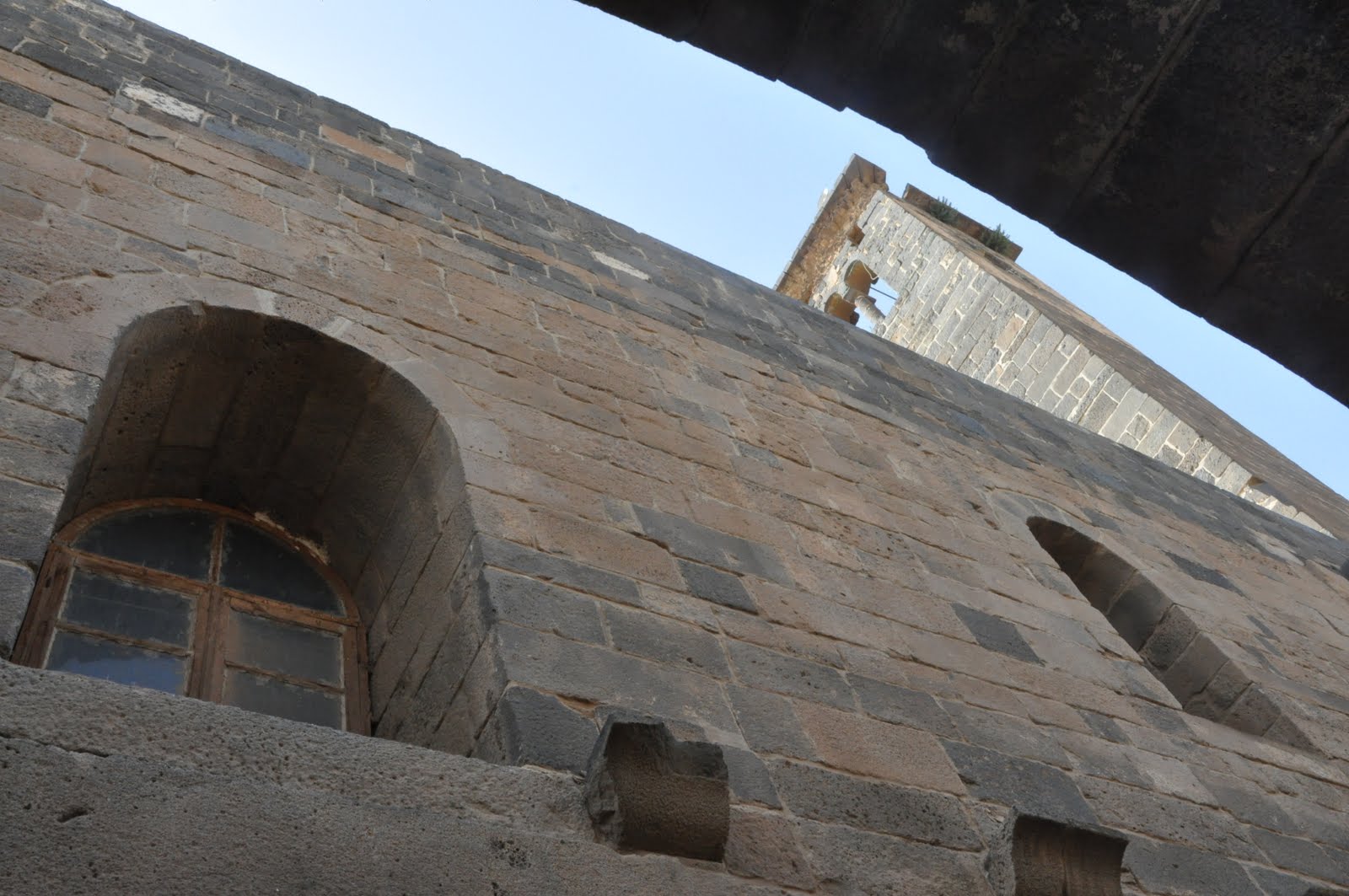
We arrived at the Prophet Ayub a.s.’s tomb around 11:09 hours. The area is facing the Golan Height or Joulan in local dialect, located along the highway to Busra. The place was well-maintained and taken care by the Local. It has few basic facilities, such as, toilets, drinkable water supply, prayer room, etc. for the visitors.
Well known for his notable patience, Prophet Ayub a.s. was from Syria and had two wives. He had become very sick and the illness spanned over 15 years. During that time, the exterior of his body became infested with worms. He believed that his flesh was the food for these creatures of Allah and to show his devotion to Allah, he allowed the worms to eat of his flesh. If a worm would fall off, he would pick it back up and put it back on his flesh.The sickness repulsed the people of Syria to the extent that he had to leave the area. Only one of his two wives chose to travel with him. They left Syria and travelled to the mountain top where his remains now lie.
During a very critical stage of his illness, Hazrat Jabriel a.s. visited him and conveyed ‘salam’, when a worm was eating his tongue. He was not able to answer to the salutation - salam of Jabriel a.s.. Jabriel a.s. came again and enquired him why he was not able to answer the salam. Prophet Ayub a.s. then, explained to Jibriel a.s, a worm was feeding from his tongue and he would have shaken his tongue or given answer to him then the worm would have lost his food.
This great act of this pleased Allah swt and as stated, his sickness lasted over 15 years. It is said that, when the worms began to eat inside his mouth, Prophet Ayub a.s. realized his breaking point and finally asked Allah for mercy. In response to this request, aware of the years of devotion and hardship, it is believed that Allah swt instructed Prophet Ayub a.s. to step out from his house and place his foot in a particular spot. When doing so a small hole in the ground opened up and from within the ground an outpouring of water occurred right next to his foot.
Allah swt then, instructed him to drink this water and upon doing so, he was not only cured of his sickness but his body was restored to the health of an 18-year-old young man. Prophet Ayub a.s. then lived until the age of 92 when he finally died and was put to rest in the very spot he dwelled all these years after his departure from Syria. In my opinion, until now, Prophet Ayub a.s.'s body remains in the same spot claimed to be at Salalah, Oman. The tomb that we went (in Syria), was, I think, the place where he inhabited before he was ‘expelled’ by the Locals then. Allah hu Alam – Allah swt knows best.

ZS4: The Valley of Yarmouk


The story of Prophet Ayub a.s. had reminded us the importance and the essentiality to subscribe ourselves to this element for our success. While imparting the story into our CPU, 15 minutes later, our coaster arrived at another nostalgic place where one of the most significant events in the Islamic history, the Battle of Yarmouk took place.
The Battle of Yarmouk‎, also spelled Yarmuk, lead by Khalid ibn Al-Walid r.a. was a major battle between the Muslim Arab forces of the Rashidun Caliphate and the armies of the Roman-Byzantine Empire. The battle consisted of a series of engagements that lasted for six days in August 636, at this place called the Yarmouk Valley. The result of the battle was a complete Muslim victory, which permanently ended Byzantine rule south of Anatolia. The battle is regarded as an example in military history where an inferior force by superior generalship manages to overcome a superior force. And, one of the most decisive battles in military history and it marked the first great wave of Islamic conquests after the death of Prophet Muhammad saw (peace be upon him), heralding the rapid advance of Islam into the then Christian Levant.
The view and the serenity of the surrounding refreshed our memory, which helped us to visualize the situation then. The companions (May Allah swt pleased with them) of Prophet Muhammad saw (peace be upon him) who had sacrificed their life and martyred during this battle had achieved a true sense of success, which all of us should learn.
After spending around 15 minutes admiring the place, we continued our journey to Busra.

Fluffy & Shaggy Syrian Sheep


Along the Syrian highway, whether you are heading North or South, you will be entertained by the Syrian natural authentic landscape. And, in many places flocks of fluffy sheep and shaggy local goat will catch your eyes. With no exception, the fluffy and shaggy thingy has attracted us and lured to stop when we were on the way to the Southern part of Syria – Busra. The Bedouin Sheppard was very cooperative and friendly. What amazed us their sheep & goats were very obedient, quite and odorless. The green fertile grass and the fresh ambience, I believed, have made them more fluffy and shaggy. Hence, the succulent Lamb chops.

Pit Stop 1 - Turkey Kebab & Strategic Planning


We had our first Pit Stop some 20 kilometers away before Busra, for our brief lunch and meeting (meeting is one of the sunnah (the way) of the great Prophet Muhammad saw) – to strategize our trip program and itinerary. It was a decent restaurant along the highway serving its specialties – turkey kebab. 100 meters away was a beautiful Masjid where we performed our obligation.
We ordered 2 kilogram of the turkey kebab or kofta (in Egypt), served with sweet grilled big onion & tomatoes, Syrian aish or bread, cucumber and ketchup. Believed me, in almost 15 minutes, all gone!!.

ZS5: Meeting place of Bahira & Abu Talib at Busra


After minutes walk, exploring the 'city', we arrived to a place claimed to be a meeting place between a famous Christian monk named Bahira and Abu Talib – the uncle of the great Messenger of Allah swt, Prophet Muhammad saw (peace be upon him). The place was one of the important items in our agenda at Busra. According to the story - by Amir and that I gathered from my reading; either when Prophet Muhammad saw (peace be upon him) was 9 or 12 years old, he accompanied his uncle Abu Talib ibn Abd Al Mutallib during their business trip with a Makkan caravan. When the caravan was passing by his cell, the monk invited them to a feast. They accepted the invitation, leaving the boy to guard the camel. Bahira (his real name was Georges), however, insisted that everyone in the caravan should come to him. He entertained them generously and lavishly. Then a miraculous occurrence indicated to the monk that Muhammad was to become a prophet.
He had never been in the habit of receiving or entertaining them before. He readily enough recognized the Prophet Muhammad saw [peace be upon him] and said while taking his hand; "This is the master of all humans. Allah swt will send him with a Message which will be a mercy to all beings." Abu Talib asked; "How do you know that?" He replied; "When you appeared from the direction of ‘Aqabah, all stones and trees prostrated themselves, which they never do except for a Prophet. I can recognize him also by the seal of Prophethood which is below his shoulder, like an apple. We have got to learn this from our books." He also asked Abu Talib to send the boy back to Makkah and not to take him to Syria for fear of the Jews. Abu Talib obeyed and sent him back to Makkah with some of his men servants.
Really...., it was an indescribable experience when all of landed our feet on this nostalgic spot. Astonished and amazed, Afi captured the serenity of the spot in his sketchbook. We met a group of South African families in front of the building before he moved on. Alhamdullillah wa Allah hu Alam.

ZS6: Exploring the Ancient City of Busra


We went straight to the Old Roman city after arriving Busra at around 13:35 hours. Alhamdullillah. Entering the city was free of charge, thus, Ahmed drove us in. Few minutes later, however, we decided to walk through the city to better enjoy the scene and feel the nostalgic sense of each single part of the city.
The walk had somehow or rather, reduced the naughty cholestrol level, the uric acid content in my blood and hopefully, enhanced our metabolism. Well, Busra that we knew; is an ancient city administratively belonging to the Daraa Governorate in southern Syria. It is a major archaeological site and has been declared a UNESCO World Heritage Site.
The settlement was first mentioned in the documents of Tutmose III and Akhenaton (14th century BC). Busra was the first Nabataean city in the 2nd century BC. The Nabataean Kingdom was conquered by Cornelius Palma, a general of Trajan, in 106. Exploring the city was a great opportunities for Afiq, Asri and Afi in enhancing their knowledge and sketching skills - creativity.
Under the Roman Empire, Busra was renamed Nova Trajana Bostra, and was the residence of the legio III Cyrenaica and capital of the Roman province Arabia Petraea. The city flourished and became a major metropolis at the juncture of several trade routes, including the Roman road to the Red Sea. The two Councils of Arabia were held at Bostra in 246 and 247 AD. The city was conquered by the Sassanid Persians in the early 7th century, but was finally captured by the forces of the Rashidun Caliphate under Khalid ibn Walid in the Battle of Busra in 634. Thereafter it was an Islamic possession. And, it is said that, Prophet Muhammad saw (peace be upon him) himself made his business trip to trade whatever he had with his first wife Sayeda Khadijah r.ah.
The above photos: M Afiq, 'Afi and the charming Syrian kid of the Old City of Busra. Subhanallah. Busra played an important part in the early life of the Prophet Muhammed saw (peace be upon him) as described in the entry for the Christian Monk, Bahira.
Today, Busra is a major archaeological site, containing ruins from Roman, Byzantine, and Muslim times, its main feature being the well-preserved Roman theatre. Alhamdullillah, praise only for Allah swt. We were very grateful that He has given us the time, wealth and strength to visit the one of the most significant place in the history of the great Messenger of Allah, Prophet Muhammad saw and also his Companions. Seeing is believing and visiting it, was an indulging experience.

ZS7: Al Umari Masjid - One of the Oldest Masjid


Al Umari Masjid, located ins ancient Roman city of Busra, is one of the oldest surviving mosques in Islamic history. It was founded in 636 by Saidina Umar ra during his helm as the second Caliph, who led the Muslim conquest of Syria. The Caliph Yazid II completed the masjid in 720. It was then, renovated and expanded in the twelfth and thirteenth centuries by the Ayyubid dynaties who also fortified the Roman theatre and baths.
Honestly, I never expected to find or visit a masjid within the Old city of Busra. Not until Amir brought us around the Old city, he told us that there is one old masjid inside the perimeter, which is use by the Locals to perform their obligation.
The masjid's plan is arranged around an enclosed courtyard wrapped with a single arcade on the eastern and western sides and a double arcade on the southern side that leads to the prayer hall. The courtyard was originally used as a market and sleeping area for traveling caravans on the trade routes across Syria, especially on the annual pilgrimage roads to Makkah. It has one of the earliest examples of an Umayyad square minaret, which was repeated in the other great Umayyad Masjid in Damascus and Aleppo.
We spent quite sometime in the masjid admiring the architecture and the layout, which mesmerized us all. It reminded us about the legacy of the second Caliph of Islam, Saidina Umar radiallah hu anh.

ZS8: The Hamman Manjak

|

One of the oldest Hammam or public bathroom in Syria or to be specific, in the middle of the old city of Busra, adjacent to the al-Umari Masjid. It is now, an open museum.
Despite went through several restoration works in the past, the original structure and design layout is still maintained.

ZS9: The Remnant of the Roman Empire@Busra


The Roman Amphitheater – one of Busra’s prominent features. However, I did not enter the theater, which is claimed to be one of the biggest ancient Roman Amphitheater ever survived and utilized in the whole world. To me, besides the architecture, it was just a mere theater! Every year there was a national music festival hosted in the main theater. The Amphitheater was the second last spot that we visited at Busra. After we roamed and visited few rows of shops, we departed for Dimasq at around 16:15 hours.

There Is Always Light at the End of the Tunnel

|

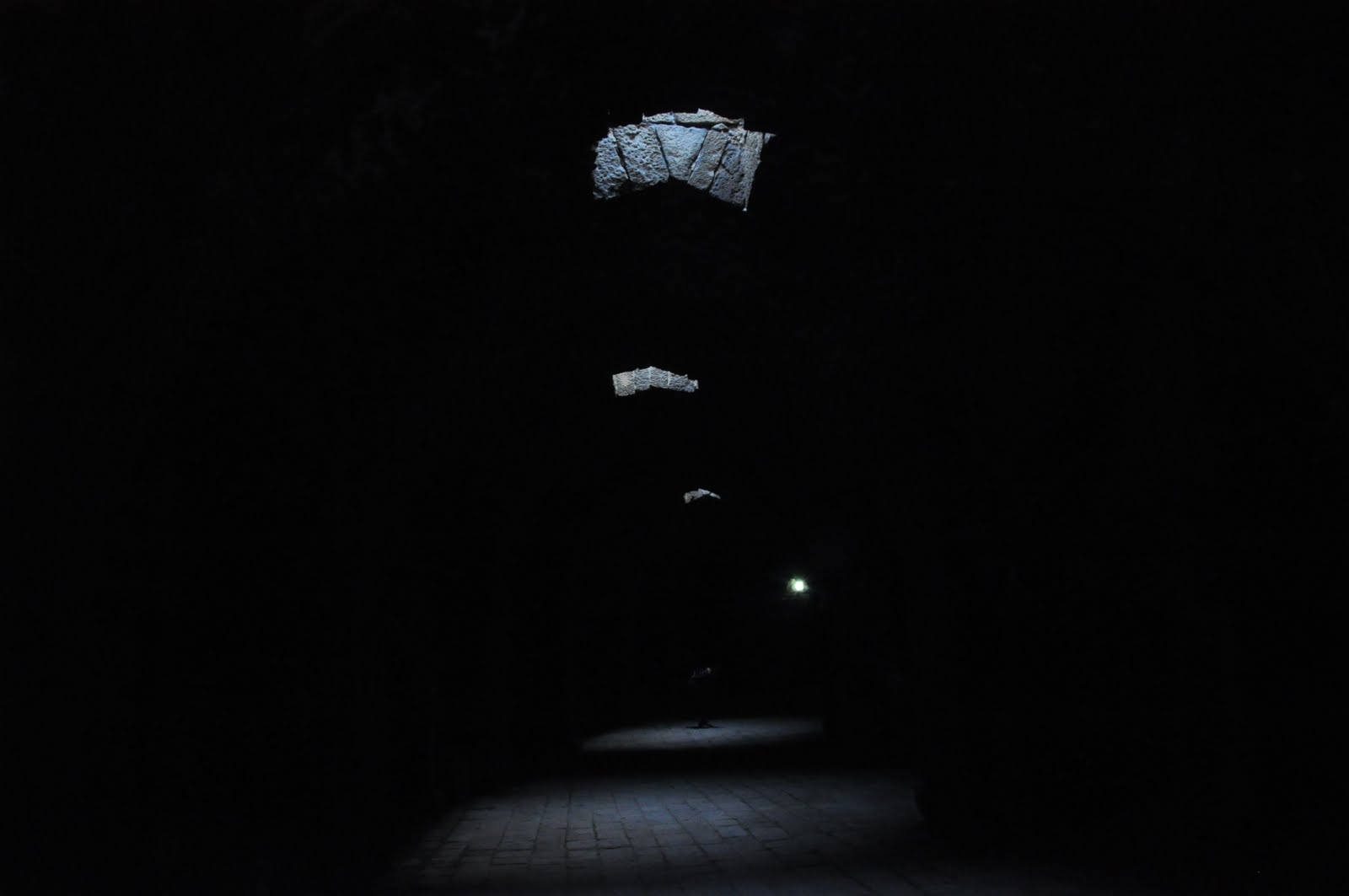
Set by Afi, Muhammad Asri took these photos when they visited the Roman Amphitheater at Busra. It was shot along the corridor of the Roman legacy and the subject was Muhammad Afiq. I called it ‘there is always light at the end of the tunnel’. Yes, Allah swt has always provided us the light, the path to achieve success. In fact, the light comes from various directions. However, it is up to us to put our efforts to find the ‘light'. Wish them all the best in their pursuit of happiness - the true sense of happiness.

Exploring the Night Life of Souk Sirijeh, Damascus

|

We arrived Dimashq around 19:10 hours and went to a place called Masaqin for what Amir called Syrian ‘Nasi Mandi’ dinner, but rather a Yemeni cuisine of Syrian Lamb and Chicken Briyani. The succulent Syrian Lamb or Lahmah Dhoni had tempted my appetite that I have to ignore the alerting level of Uric acid circulating in my blood. The Yemenian relaxation style of dining was another memorable experience for all the kids.
The above photo: Amazed by the architecture of Bab el Jabieh and enthusiastively attentive listening to Amir's story of one of the seven doors of the old city.
After the dinner, we took two taxis to one of the well-known spots of Dimashq that is well known by tourist, the Souk Hamidiyyah or Souk Hamidi by the Local. Actually, our main intention was to perform our obligation at the Grand magnificent Umayyad Masjid or Masjid Umawi in the Local dialect, which is one of the most prominent features of Syria. I will share about the Masjid in my later entry.
Various colors and taste of the local olives that decorated the alley of Souk Sarijeh. In the photo below: all sorts of local fruits were nicely presented to lure customers. Awesome, aren't there?
After had satisfactorily fulfilled our obligation, we went to Souk Thawil or the Long Bazaar or Madha Pasha Bazaar, which is parallel with Souk Hamidi. Most of the shops out of service I mean closed. All the places I mentioned above are within the old city of Damascus, which has 7 main Gates. And, one of it is Bab el Jabieh, which we went through to Souk Sarijeh (am not too sure I pronounce it correctly) in the Local dialect.
Nana bought some pastries and a kilo of the local orange or Buktuqal. The price - was rediculously cheap.!
Can't remember the name of this species. There were warmed above the hot charcoal.
Goat head or Ras Khorouf was very popular in Syria. One could find many restaurants serving the dish. How they serve and consume was not sure for me though. Nevertheless, it was an eye opening experience to the kids. All this while, they normally heard about the goat head story in one of the hadiths during our ‘ta’lim’ session.
There were few pastries masteries and/or halawat shops along the Souk. We bought something similar to baklawah in Egypt – I think Manahourah (please do not quote me!). I must say; it was really mouth watering crumply delicacies.
We tried these sweety deserts, made from cheese, milk, wheat, sugar and sprinkled/decorated with sliced pistachios. I have tasted both and must say - yummy, yummy....delicious.
Souk Sarijeh was basically accommodating the Local produces vendors, which was still busy during this odd ours. The people that we met were very friendly, accommodative, helpful and polite. It was really an awesome experience roaming the alley in the middle of the night entertained by the beautiful colors, shapes and characters of the inhabitants. Despite the hectic agenda, most of us still have sufficient energy to walk through the nite. Anyway, we decided to call it a day - time ticked 23:37 hours. Masalamah

Morning Walk along D'Mas Back Lane

|

The main item in our second day agenda was visiting the tomb and shrine of many important prominent people in the Islamic history – a trail blazer on their own businesses. Among them was Bilal bin Rabah radiallah hu anh (ra); Abu Hurairah ra; the wives of the Messenger of Allah swt and many more.
We had a superb sleep and after fully recovered from the day 1 hectic program, we started our day by strolling leisurely along the back lane of the downtown Damascus.
It was around 07:30 hours, amid the chilly freshly ambience of Dimashq, many shops were still closed. The lane provided an opportunity to experience and admires the architecture of the old buildings. Akin to some other parts of the Middle East downtowns and villagers, the building looks old and decent from outside but, it will be another totally different picture if you go in. The saying goes; ‘don’t judge the book by its cover’.
The street however, was filled by gorgeous and charming Syrian kids headed to their respective schools. Some old men were preparing their kiosks gave us their hospitable smile and greetings that cheered our day. Not Ayman though, he was still dozing off, I mean sleep-walking!

Syrian Breakfast to Start the Day

|

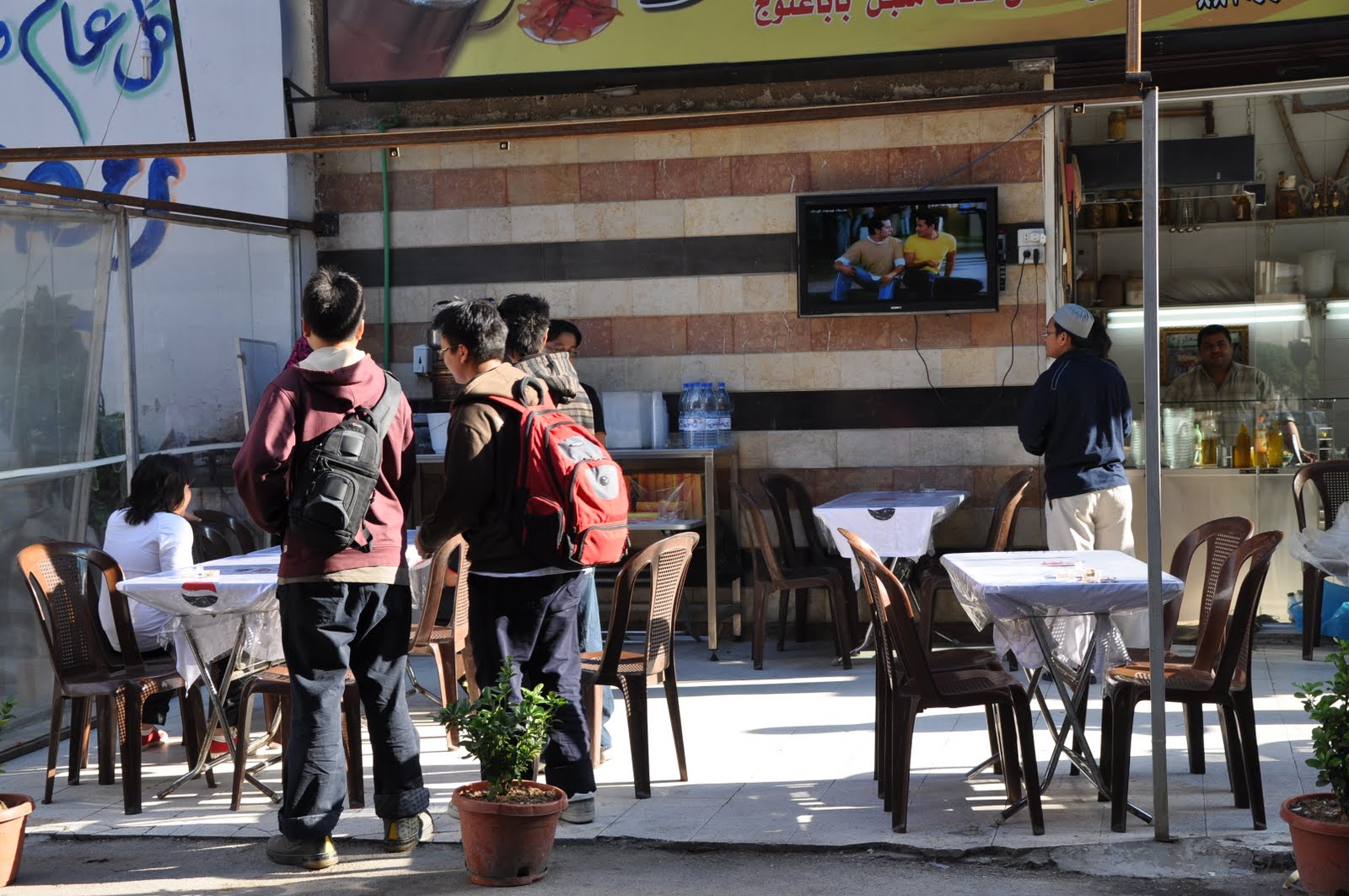
After around 15 minutes walk, we stopped at this small restaurant along the main road to fullfil our biological needs. Relatively speaking, it was still early for the people, thus, there was basically only us patronizing the clean and hygiene restaurant. Besides the cleanliness and its decency, the hospitality of the crew were commendable and it has flat screen TV with satellite decoder attached to it.
Albeit the menu did not show us ‘Nasi Goreng’ or ‘Roti Canai’ or other typical Malaysian breakfast set, we had really, an excellent Syrian breakfast. The ‘humus ma halib’ or blended chick peas with yoghurt with some mint, etc. was the main dish of the day. Almost four medium size of this dish were consumed with some assorted local pickled. . I am quite lucky that, my team – wife and kids were not fussy with food and very adventurous in many aspects – clothing, accommodation, transportation or even the program itself. They were very cooperative and understanding. Thanks team.
Based on our agreed plan, today, we spent 90% of the day on foot. Hence, he breakfast was quite essential that had kept us energized.